
$x_S$ is some subset of the set $S$, the complement of this subset can be demonstrated as $x_{-S}$.
\(\begin{equation}
\mathsf{D} = \alpha \mathsf{B} + c \implies D_{i,j} = \alpha B_{i,j} + c
\end{equation}\)
Broadcasting:
\(\begin{equation}
\mathsf{D} = \mathsf{A} + b \implies D_{i,j} = A_{i,j} + b_j
\end{equation}\)
Elements of $b$ are added to each row of the matrix $\mathsf{D}$.
Since dot product gives a scalar it is a commutative operation in the following way: \(x^\top y = (x^\top y)^\top = y^\top x\)
Matrix Multiplication
\(\begin{gather} \mathsf{C} = \mathsf{AB} \\ C_{i,j} = \sum_k A_{i,k} B_{k,j} \end{gather}\) (each element in the matrix $\mathsf{C}$ is calculated via a dot product of $i$th row of $\mathsf{A}$ and $j$th column of $\mathsf{B}$.)
If $x$ and $y$ are solutions to $\mathsf{Ax} = \mathsf{b}$, then $z = \alpha x + (1 - \alpha)y$ is also a solution for any $\alpha \in \mathbb{R}$.

$x_1$ determines how much to go in $A_{:,1}$ direction.
Therefore for each element of the resulting vector we will have $\mathsf{A} x = \sum_i x_i A_{:,i}$, where $x_i A_{:,i}$ is a scalar multiplication of $x_i$ and all elements of the $A_{:,i}$ column vector.
The vector-matrix multiplication operation can be translated into a linear combination of the column vectors of the original matrix, multiplied with each element of the vector column: \(\alpha A_{:,1} + \beta A_{:,2} + \gamma A_{:,3}\)
From the above, we see that $\mathsf{b}$ will be a solution of $\mathsf{Ax} = \mathsf{b}$ only when it is in the column span (range) of $\mathsf{A}$.
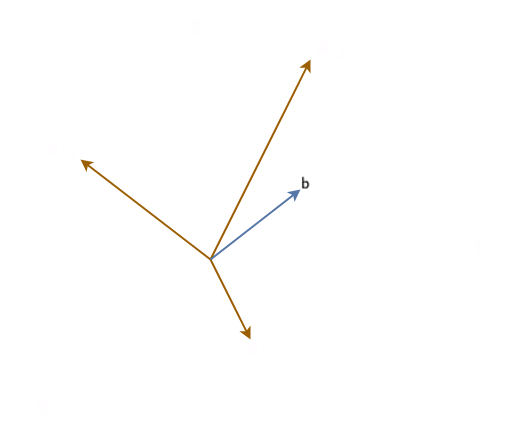
$\mathsf{b}$ can be thought of as being pulled $x_1$ quantity in $A_{:,1}$ direction $x_2$ times in $A_{:,2}$ direction and $x_3$ times in $A_{:,3})$ direction. We need $\mathsf{A}$ to have at least $m$ independent columns in order to define $\mathbb{R}^m$ as their column space ($n \ge m$).
if $\mathsf{A}$ is a $3 \times 2$ matrix and $\mathsf{b}$ is $3 \times 1$, $x$ is 2-dimensional, so $x$ defines only a 2-D plane within $\mathbb{R}^3$, the equation has a solution iff $\mathsf{b}$ lies on that plane.
flowchart TD

a["conditions"] --> b["have to at least describe m-dimensions"] & c["m-vectors should be linearly independent"]
b --> c
$x = \mathsf{A}^{-1}\mathsf{b}$ : at most one solution for each value of $\mathsf{b}$
If overdetermined ($n \ge m$), there is more than one way to parameterize the solution.
Any Norm function will be of the following form: $f : V \rightarrow \mathbb{R}$
$L^0$ norm which corresponds to the number of non-zero entries in a vector is not a valid distance metric as scaling the vector by $\alpha$ does not change the number of non-zero entries.
Infinity Norm: \(\begin{equation} \lVert x \rVert_\infty = \underset{i}{\max} | x_i | \end{equation}\) This norm measures the maximum discrepancy between two elements in a vector.
Frobenius Norm: \(\begin{equation} \lVert \mathsf{A} \rVert_F = \sqrt{\sum_{i,j}A^2_{i,j}} \end{equation}\) Frobenius Norm is considered w.r.t a matrix, for vectors (or single column matrices) this will be equivalent to the $L^2$ norm of the vector.
Vectors having $\lVert \cdot \rVert_2 = 1$ and $x^\top y = 0$ are called orthonormal vectors.
Diagonal Matrices: Diagonal Matrices have only diagonal elements, rest are all zeroes.
\(\text{diag}(v) = \begin{pmatrix} v_1 & 0 & 0 & \dots \\ 0 & v_2 & 0 & \dots \\ 0 & 0 & v_3 & \dots \\ \vdots & \vdots & \vdots & \ddots \end{pmatrix}\) \(\text{diag}(v)^{-1} = \text{diag}\left(\left[\frac{1}{v_1}, \dots, \frac{1}{v_n}\right]^\top \right)\) \(\text{diag}(v)x = v \odot x\) \(\underbrace{\huge{\mathsf{D}}}_{\text{diagonal}}x\)
For a non-square tall diagonal matrix zeroes are added to the end of the matrix. For a wide matrix, elements of $x$ are dropped during multiplication.
Symmetric Matrices: $\mathsf{A} = \mathsf{A}^\top$
Singular Matrices: Square matrices with linearly dependent columns.
Orthogonal Matrices: rows (columns) mutually orthonormal \(\begin{gather*} \mathsf{A}^\top \mathsf{A} = \mathsf{A} \mathsf{A}^\top = I \\ \mathsf{A}^{-1} = \mathsf{A}^\top \end{gather*}\)
Eigenvectors and Eigenvalues
\(\mathsf{A} v = \underbrace{\lambda}_{\text{eigenvalue}} \overbrace{v}^{eigenvector}\) \(v^\top \mathsf{A} = v^\top \lambda \, \, : \, \, \text{ right eigenvector \& eigenvalue}\)
\(\mathsf{A} (sv) = \lambda (sv) \, \, , \, \, \forall s \in \mathbb{R} , s \not = o\) \(\begin{gather*} \mathsf{A}v = \lambda v \, \, \text{ and } \, \, \mathsf{A}u = \lambda u \\ \mathsf{A} v + \mathsf{A} u = \lambda v + \lambda u \\ \mathsf{A}(v + u) = \lambda (v + u) \\ \implies \mathsf{A} ( \alpha v + \beta u ) = \lambda ( \alpha v + \beta u ) \end{gather*}\)
Matrix $\mathsf{A}$ has $n$ linearly independent eigenvectors ${ v^{(1)}, \dots, v^{(n)} }$ and corresponding eigenvalues ${ \lambda_1, \dots, \lambda_n }$.
Concatenating the vectors (one vector per column):
\(\begin{gather*}
V = \left[ v^{(1)}, v^{(2)}, \dots, v^{(n)} \right] \\
\lambda = [\lambda_1, \lambda_2, \dots, \lambda_n]^\top
\end{gather*}\)
Eigendecomposition:
\(\begin{equation}
\mathsf{A} = V \text{diag}(\lambda) V^{-1}
\end{equation}\)
For any Real Symmetric Matrix we have:
\(\begin{equation}
\mathsf{A} = Q \Lambda Q^\top
\end{equation}\)
where $Q$ is the diagonal matrix of eigenvalues and $Q^\top$ is orthogonal matrix of eigenvalues of $\mathsf{A}$. Eigendecomposition is guaranteed for real symmetric matrices, but they might not unique.
$\Lambda_{i,i}$ is eigenvalue related to $i$th column of $Q$ ( $Q_{:,i}$ ), since it’s orthogonal (independent basis) we can think of $\mathsf{A}$ as scaling space by $\lambda_i$ in direction $v^{(i)}$ . If $\lambda_i = 0$, matrix is singular.
\(\begin{align*} &\mathsf{A} = Q \Lambda Q^\top& \\ &Q^\top \mathsf{A} \, Q = \Lambda& \\ &x^\top \mathsf{A} \, x = f(x)& \, \, s.t. \lVert x \rVert_2 = 1 \\ &v_1^\top \mathsf{A} \, v_1 = \lambda_1& \end{align*}\) where $\lambda_1$ is eigenvalue corresponding to the specific eigenvectors.
$x^\top \mathsf{A} \, x = 0 \implies x = 0$ : A matrix whose eigenvalues are all positive : positive definite
$\forall x, x^\top \mathsf{A} \, x \ge 0$ : A matrix whose eigenvalues are all positive or zero : positive semidefinite
A matrix whose eigenvalues are all negative : negative definite
A matrix whose eigenvalues are all negative or zero : negative semidefinite